Gabions are metal cages filled with stone, forming a flexible, permeable, and interlocking structure. They are used for various functions, including retaining walls, slope protection, and flood control. They are a great solution for both modern water projects and ecological restoration.
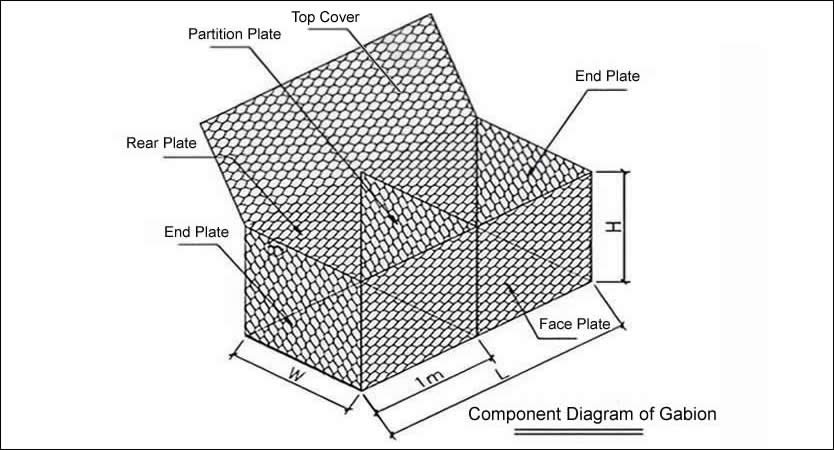
Basic Components
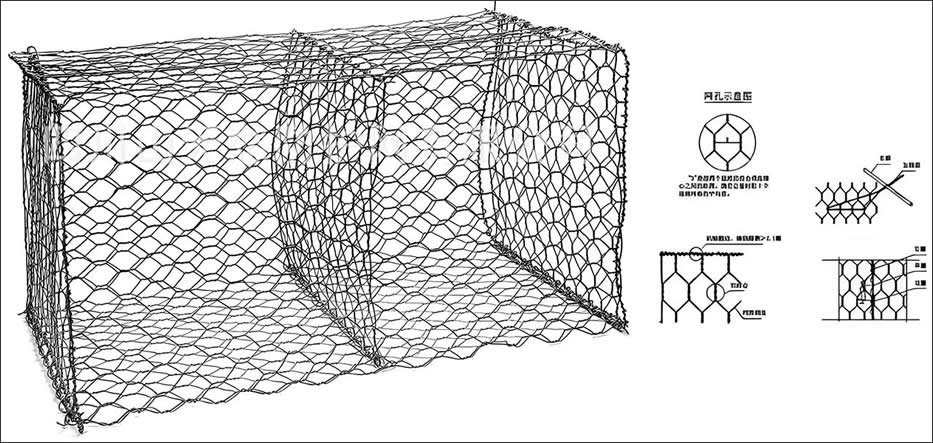
Gabion box is a modular structure made from a metal wire mesh filled with rocks. The mesh is typically a twisted hexagonal wire netting made from high-strength galvanized steel, zinc-aluminum alloy (Galfan) coated wire, or PVC-coated wire. Gabion boxes are available in cube or rectangular formats, composed of bottom, side, partition, and cover panels, assembled using spiral wire or ring ties.
- Wire tensile strength is ≥380 N/mm².
- Mesh wire diameters: 2.0–4.0 mm
- Edge wire: 0.5–1.0 mm thicker
- Binding wire: approx. 2.2 mm
- Standard mesh sizes: 60×80 mm, 80×100 mm, 100×120 mm
- Twist length: ≥50 mm for coating protection
- Common sizes: length 2–4 m, width 1 m, height 0.5–1 m
- Filling material: Hard stone or pebble, ~1.5× mesh size, sharp-edged for interlocking strength
Internal Structural Design
- Partition Walls: Vertical dividers spaced every 1 m reinforce internal stability and reduce rock displacement.
- Edge Reinforcement: Thicker edge wires combined with spirals or steel rings enhance structural integrity during lifting and installation.
- Sealing Method: Panels and covers are tied securely to form a sealed load-bearing structure that resists rock loss under water pressure or environmental stress.
Key Structural Properties
- Flexibility: Wire mesh adjusts to ground settlement, reducing the risk of cracking or tipping.
- Structural Integrity: Local damage does not affect overall performance. Load-bearing is achieved via gravity, friction, and stone interlock.
- Water Permeability: Voids between rocks (20–30%) allow drainage, reducing hydrostatic pressure and encouraging plant growth.
- Durability: Surface treatments like hot-dip galvanizing or PVC coating extend lifespan from 30 to 120 years, requiring low maintenance.
Extended Gabion Structures
- Gabion Mattress: With a height of 0.17–0.3 m, used in riverbeds or slope erosion protection due to high surface adaptability.
- Reinforced Gabions: Include geogrid or steel strips on the back side, designed for use in vertical walls 5–10 m high.
- Landscape Gabions: Designed for aesthetics, with integrated planting spaces or soil layers to support greenery, seating, or decorative features.
Installation and Maintenance
Gabion panels are factory-woven and folded for shipment. On-site, boxes are assembled, filled layer by layer with compacted rock, and sealed.
- Construction: Fast and efficient; no formwork, power, or concrete needed
- Maintenance: Post-flood inspections and spot repairs are sufficient; no extensive upkeep is required
Steps to Build a Gabion Box Structure with Standard Sizes and Specifications
- Site Preparation and Foundation Dimensions: Clear vegetation, debris, and loose soil from the installation area. Excavate a trench 100–300 mm deep and 200–300 mm wider than the gabion width. Compact the subgrade to ≥95% Proctor density. For soft soil, install non-woven geotextile weighing 150–300 g/m². Add a crushed stone base layer 100–150 mm thick and compact it. Ensure level tolerance remains within ±10 mm per 3 m.
- Gabion Box Sizes and Mesh Specifications: Common gabion box dimensions include 1 × 1 × 1 m, 2 × 1 × 1 m, 3 × 1 × 1 m, 2 × 1 × 0.5 m, and 2 × 1 × 0.3 m. Mesh openings typically measure 60 × 80 mm, 80 × 100 mm, or 100 × 120 mm. Wire diameter ranges from 2.7–3.0 mm, while selvedge wire measures 3.4–3.9 mm. Zinc coating should be 240–300 g/m². Install diaphragms at 1 m intervals for boxes longer than 1 m.
- Assembly of Gabion Baskets: Unfold panels on flat ground. Connect panels using spiral binders with a 3.0–4.0 mm diameter or lacing wire with a 2.2–2.7 mm diameter. Maintain right angles at 90° ± 2°. Ensure vertical deviation does not exceed 1/200 of the height. Secure all edges at lacing intervals of 100–150 mm.
- Placement and Structural Alignment: Position baskets in the trench according to the layout. Maintain horizontal alignment within ±20 mm per 10 m. Stacking height varies: single layers range from 0.3–1.0 m, while multi-layer walls reach up to 3–6 m. Connect adjacent units along vertical edges. Overlap connection points every 100–150 mm. Use bracing wires at 300 mm vertical spacing during filling.
- Stone Fill Requirements and Compaction: Use angular stone such as granite or limestone. Stone size ranges depend on mesh size: 80–120 mm for 60 × 80 mm mesh, 100–150 mm for 80 × 100 mm mesh, and 120–200 mm for 100 × 120 mm mesh. Place fill in 300 mm layers. Manual face placement is recommended for visible surfaces. Avoid a void ratio exceeding 30–35%. Overfill by 25–40 mm to allow for settlement.
- Lid Closing and Edge Securing: Fold the lid over the top after filling. Pull it tight to ensure contact with the stones. Secure the lid with spiral binders or lacing wire at 100 mm intervals. Trim excess wire ends to a projection of ≤10 mm. Check that top deflection does not exceed 20 mm.
- Final Inspection and Maintenance Standards: Check for panel bulging greater than 50 mm, loose connections, and uneven settlement exceeding 50 mm. Inspect the structure every 6–12 months. Add stone if settlement exceeds 5% of the height. The service life of galvanized gabions ranges from 20–50 years, depending on the environment.